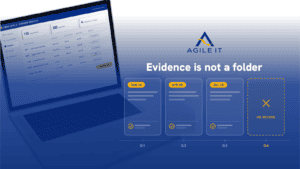
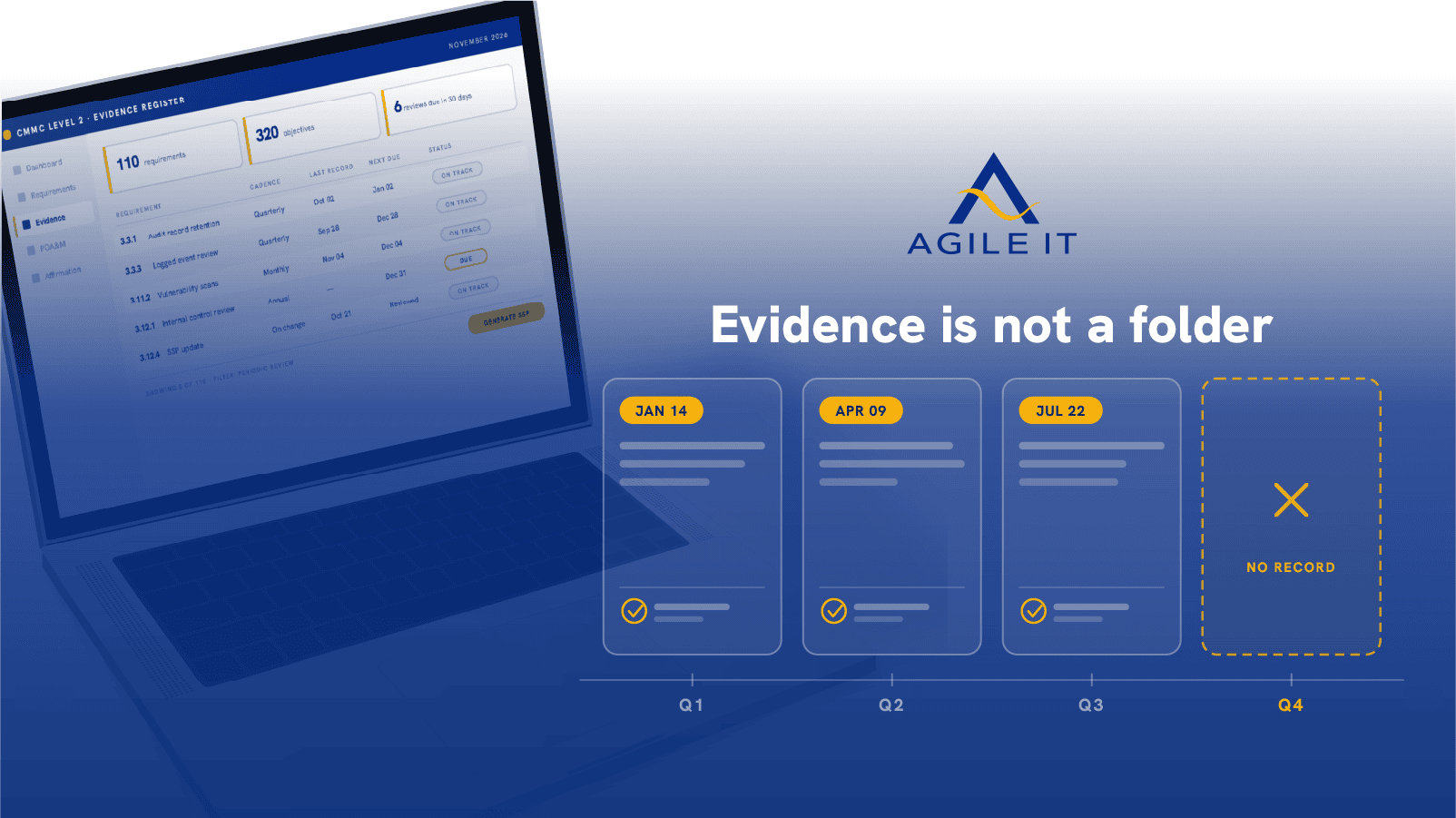
A folder of screenshots assembled the week before an assessment does not demonstrate ongoing compliance. CMMC assessors use evidence as a proxy for the institutionalization of the CMMC-compliant policies and procedures. For example, a screenshot may show a list of users that are enrolled in Entra; but the context behind how the users are approved—user’s role is in the CUI data flow, user has documented evidence that they completed the required training, user passed a background check—is the larger body of evidence that shows institutionalization of the compliance effort.
Assessors Examine, Interview, and Test
The Assessment Guide names three methods that assessors can use to evaluate compliance with the objectives. Examine means “reviewing, inspecting, observing, studying, or analyzing assessment objects.” Interview means “holding discussions with individuals or groups of individuals.” Test means “exercising assessment objects.”
Assessors are “not expected to employ all assessment methods and objects,” and they “exercise judgment in determining when sufficient and adequate evidence has been presented.” The assessor is free to choose the method that they feel best suits the objective and your organization. However, your evidence has to hold up under whichever method the assessor picks for a given objective.
Fail a Single Objective = Fail the Requirement
Only 23 requirements have a single objective; the remaining 87 requirements have at least 2 and upwards of 12 objectives. A requirement is deemed MET when “all of the assessment objectives for the requirement are satisfied based on evidence. If one of the objectives is NOT MET then the organization receives no credit for the parent requirement. One missing record for a minor objective can turn a requirement your organization performs into one it cannot demonstrate.
Drafts Do Not Count
The CMMC Assessment guide is blunt on this point: “Documents need to be in their final forms; drafts of policies or documentation are not eligible.” Elsewhere it lists “working papers, drafts, and unofficial or unapproved policies” as unacceptable forms of evidence.
In practice, a policy needs an approval, a version, and a date—and needs to be implemented! A review needs a record created when the review happened, not reconstructed afterward. A screenshot taken this week of a setting configured last year proves the setting exists today, and nothing about the eleven months before it. Be forward thinking about creating and collecting evidence that shows ongoing implementation of the policies and overall compliance efforts!
The Requirements That Run on a Schedule
Evidence needs to record and show how a process runs over time.
There are more than 25 objectives with a requirement that they receive a “periodic” review. The CMMC Assessment Guide requires that the period of review be at least once per year, but many objectives will require more frequent review. The reality of how often you conduct these reviews needs to be clearly articulated in policy and the review period needs to be appropriate and relevant to the organization, organizational risks, and industry best practices. The assessor will be looking for you to justify a specific review period; if you are able to show a reasonable justification, then it is likely that the assessor will be satisfied. If the review period is chosen at random or the max duration of one year is selected without supporting information, the assessor will be skeptical. For example, if an organization is seeking their CMMC L2 certification because it is a condition of award, but they do not expect to ever hold CUI, then it may be appropriate to review CUI users annually. However, another organization that routinely works with CUI and has high staff turnover may need to review CUI users on a more frequent basis, such as monthly or quarterly. In both cases, the Assessor will be looking in the organizational Risk Assessment document for indications of the level of risk and how the review frequency would be driven by the risk levels. The organizational risks should be the main driver of the frequency of review.
What follows covers what assessors examine, which requirements run on a schedule, where the record lives in a Microsoft environment and how long it stays there, and what the annual affirmation turns all of it into.
More than 25 NIST SP 800-171 Rev 2 requirements carry the requirement for a period reviewing their own text, and/or imply one through their assessment objectives. In the table below, we provide the requirements that often have a discrepancy between the policy statements and the evidence record.
| Requirement | What the schedule demands | Where the record usually comes from in Microsoft environments |
| 3.3.1 Create and retain audit records | Retention requirements defined, and records “retained as defined” (800-171A objectives [e] and [f]) | Microsoft Entra and Microsoft Purview audit logs, plus wherever they are archived |
| 3.3.3 Review and update logged events | A defined review process, followed | Dated review notes or tickets showing which event types were checked and what changed |
| 3.11.1 Periodically assess risk (Risk Assessment) | Risk assessment at the interval your policy sets, no longer than one year | Approved, dated risk assessment and the decisions that came out of it |
| 3.11.2 Scan for vulnerabilities periodically and when new vulnerabilities are identified | Scans on schedule, plus scans triggered by new vulnerabilities | Vulnerability scan reports with dates and remediation tickets |
| 3.12.1 Periodically assess security controls | Internal control assessments on schedule | Dated assessment reports with findings carried to the POA&M |
| 3.12.3 Monitor security controls on an ongoing basis | Monitoring that runs continuously, with a record of what it found | Alerts, triage notes, and tickets |
| 3.12.4 Develop, document, and periodically update system security plans | SSP updates on schedule and after changes | SSP version history and approvals |
| 3.14.5 Perform periodic scans and real-time scans of files | Scheduled scans plus real-time scanning | Endpoint protection scan history and device compliance reports |
Source: NIST SP 800-171 Rev 2 requirement text; NIST SP 800-171A objectives for 3.3.1 and 3.3.3. [Verify the 800-171A objectives for 3.11.1 and 3.12.1 before publish; we expect “frequency defined” and “performed with the defined frequency,” matching 3.3.3.]
Your Policy Says 90 Days. Entra Keeps 30.
Audit log retention is one that can be problematic for companies, because the default settings within a cloud environment can conflict with policy unless someone changes the defaults. We’ve pulled the Audit requirements here into its own section.
Requirement 3.3.1 has two objectives that trip organizations running Microsoft clouds: retention requirements for audit records are defined, and audit records “are retained as defined.” Your policy sets the number. Your tenant has to keep the logs for the specified duration.
Microsoft’s own documentation sets the defaults. Microsoft Entra keeps Audit logs and sign-in logs for 30 days on P1 and P2 licenses, and 7 days on the free tier. Microsoft Purview Audit (Standard) keeps records for 180 days, and Audit (Premium) keeps Entra, Exchange, OneDrive, and SharePoint records for one year by default.
| Log source | Default retention (Microsoft documentation) | Longer retention |
| Entra audit and sign-in logs, P1 or P2 | 30 days | Route to an Azure storage account or event hub through Azure Monitor, or use Purview Audit (Premium) |
| Purview Audit (Standard) | 180 days | Audit (Premium) |
| Purview Audit (Premium), Entra, Exchange, OneDrive, SharePoint records | 1 year | Audit retention policies; 10-year retention needs a per-user add-on |
.
The way forward is direct, achievable, and effective. Write the retention number into the policy, then configure the tenant to meet it: archive Entra logs, confirm the Purview tier your licenses include, and record the configuration as evidence for 3.3.1 itself.
One Completed Review Proves One Review
An access review completed last month proves one access review. It says nothing about the three quarters before it, and an assessor reading a policy that says “quarterly” will be expecting to see evidence that supports a quarterly review.
The record that holds up has a few properties:. It was created when the work happened, it names who performed it, it shows what was found, and it links to whatever was changed as a result. A ticket opened during the review and closed when the finding was fixed carries all four.
When Agile IT performs periodic reviews for an organization, an Agile IT staff member performs the review, consults with the organization’s team (if necessary), and documents the actions in a tickets. The point is less who does it than that the evidence shows the policy being followed.
Changes Leave Evidence Too
Periodic reviews are half of the record. The other half is what happened every time the environment changed between them.
The CMMC Program FAQ lays out the sequence it expects (F-A5). Before a change: a security impact analysis under CM.L2-3.4.4, a review of CUI flow under AC.L2-3.1.3, an entry in change management under CM.L2-3.4.3, and a review with the Affirming Official. During it: an Operational Plan of Action under CA.L2-3.12.2. After it: an updated SSP under CA.L2-3.12.4.
Each step produces a document, and each document is evidence that the change was managed. A tenant that gained Microsoft 365 Copilot, a new conditional access policy, or a second GCC High enclave this year should have that trail for each one.
What an Evidence Calendar Looks Like
The calendar below is illustrative. Your policies set the intervals, and the Assessment Guide caps any “periodically” at one year. The structure is the part worth copying: every row has a cadence, an owner, a record, and a place the record lands.
| Activity | Example cadence set by policy | Owner (role) | The record | Where it lands |
| Review logged event types (3.3.3) | Quarterly | Security lead | Review note listing event types checked and changes made | GRC platform, linked ticket |
| Confirm audit log retention matches policy (3.3.1) | Quarterly, and after any license change | Microsoft 365 administrator | Retention settings export and archive check | GRC platform |
| Risk assessment (3.11.1) | Annually, and after significant change | Compliance owner with the Affirming Official | Approved risk assessment | Document library, version controlled |
| Vulnerability scans (3.11.2) | Monthly, plus on new critical vulnerabilities | IT operations | Scan report and remediation tickets | Ticketing system, summarized in GRC |
| Internal control assessment (3.12.1) | Annually | Compliance owner | Assessment report, findings to POA&M | GRC platform |
| SSP update (3.12.4) | After each change, reviewed at least annually | SSP owner | New SSP version with approval | GRC platform |
| Affirmation review | Annually, before the SPRS affirmation | Affirming Official | Sign-off memo referencing the records above | Board or leadership file |
Every Record Needs an Owner
Evidence programs rarely fail because nobody cared. They fail because the person who ran the quarterly review left, and nobody inherited the calendar.
Each requirement with a schedule needs a named owner, a backup, and a place where the record lands. The glossary definition we work from is short: processes generate evidence, tools generate data, and assessors validate evidence, not intent.
A GRC Tool Holds the Evidence. People Produce It.
A governance, risk, and compliance (GRC) platform is the right place to keep your evidence of compliance with the objectives and requirements. It maps policies to assessment objectives, tracks what is due, and keeps the plan current when the environment changes. Each of the 320 objectives needs to be addressed in policy and relevant evidence needs to be collected and stored that shows compliance. For many of the objectives, there will be multiple pieces of evidence that demonstrate proof of periodic reviews.
Agile IT highly recommends the use of a Governance, Risk, and Compliance (GRC) tool to assist with the management of the policies and evidence. Many of the tools are CMMC focused and can consume the policies and evidence and organize them based on their content. It gets better. The GRC tool can generate a Systems Security Plan (SSP) from the uploaded information. Having completed SSPs by hand, we will attest that it is tedious and time consuming—time that you will never get back. By our estimates, the use of a GRC tool can reduce SSP development time by more than 100-200 hours.
The Affirmation Signs Whatever the Record Says
32 CFR 170.22 requires a senior official for the Organization Seeking Certification (OSC) to affirm, in SPRS, that the organization “has implemented and will maintain implementation of all applicable CMMC security requirements.” Affirmations follow every assessment and recur annually, which the DoW CIO’s CMMC FAQ confirms for all CMMC levels (C-A1).
The Phase 2 suspension did not touch this. The Department of War’s July 13, 2026 release keeps every Phase I self-assessment requirement in place, and DFARS 252.204-7019 still requires a current assessment in SPRS for covered contracts.
The FAQ also says what happens at the next assessment. It “will evaluate whether each of these changes have been properly managed according to CMMC security requirements and performed as stated in the SSP,” and “failure to sufficiently demonstrate adherence to the previous SSP may result in a future failed assessment” (C-A12).
Read together, the affirmation is a statement about the evidence that will exist when someone asks for it. The Affirming Official signs it every year whether or not anyone has looked.
Start the Evidence Clock Now
The best time to plant a tree is 10 years ago. The second best time is now. Evidence cannot be produced retroactively, so the only way to demonstrate annual ongoing compliance is to start twelve months ahead. Remember that the assessor is looking for ‘Institutionalization’ of the compliance controls. Not a one-off, and certainly not one piece of evidence for a control that has recurring review requirements.
Common Questions About CMMC Evidence
What does “periodically” mean in a CMMC Level 2 assessment?
The CMMC Assessment Guide, Level 2, defines it as occurring at a regular interval determined by the organization that may not exceed one year. The duration the organization selects should have a basis—e.g. the organizational risk assessment or industry best practices. The interval your policy sets is the one the assessor tests against.
Can draft policies count as evidence?
No. The Assessment Guide states that documents must be in final form and lists working papers, drafts, and unofficial or unapproved policies as unacceptable evidence.
Do assessors use all three assessment methods for every requirement?
No. The guide states assessors are not expected to use every method and object, and that they use judgment to decide which method(s) to use and when evidence is adequate and sufficient. Evidence has to hold up under whichever method is chosen.
How long does Microsoft Entra keep sign-in and audit logs?
Thirty days on Entra ID P1 and P2, and 7 days on the free tier, per Microsoft’s documentation. Longer retention requires routing the logs to storage through Azure Monitor or using Microsoft Purview Audit (Premium). Retention changes are not retroactive.
Does a GRC tool make an organization ready for assessment?
No. A GRC platform organizes the SSP and evidence. The reviews, approvals, and remediation that generate the evidence are still performed by people on the schedule the policies set.
What does the annual CMMC affirmation attest to?
Under 32 CFR 170.22, the Affirming Official attests that the organization has implemented and will maintain all applicable CMMC security requirements. It is entered in SPRS after each assessment and annually.
Confirm Your Evidence Trail Holds
AgileThrive keeps the CUI boundary, SSP, policies, and POA&M items aligned with what the environment does, on a documented review schedule. Agile IT owns the documentation structure, evidence tracking, and review cadence within agreed scope, and your organization owns governance decisions and the sign-off.
Pick one requirement your policy says your organization performs quarterly: can you produce the last four records, dated and attributed, before the end of the day?