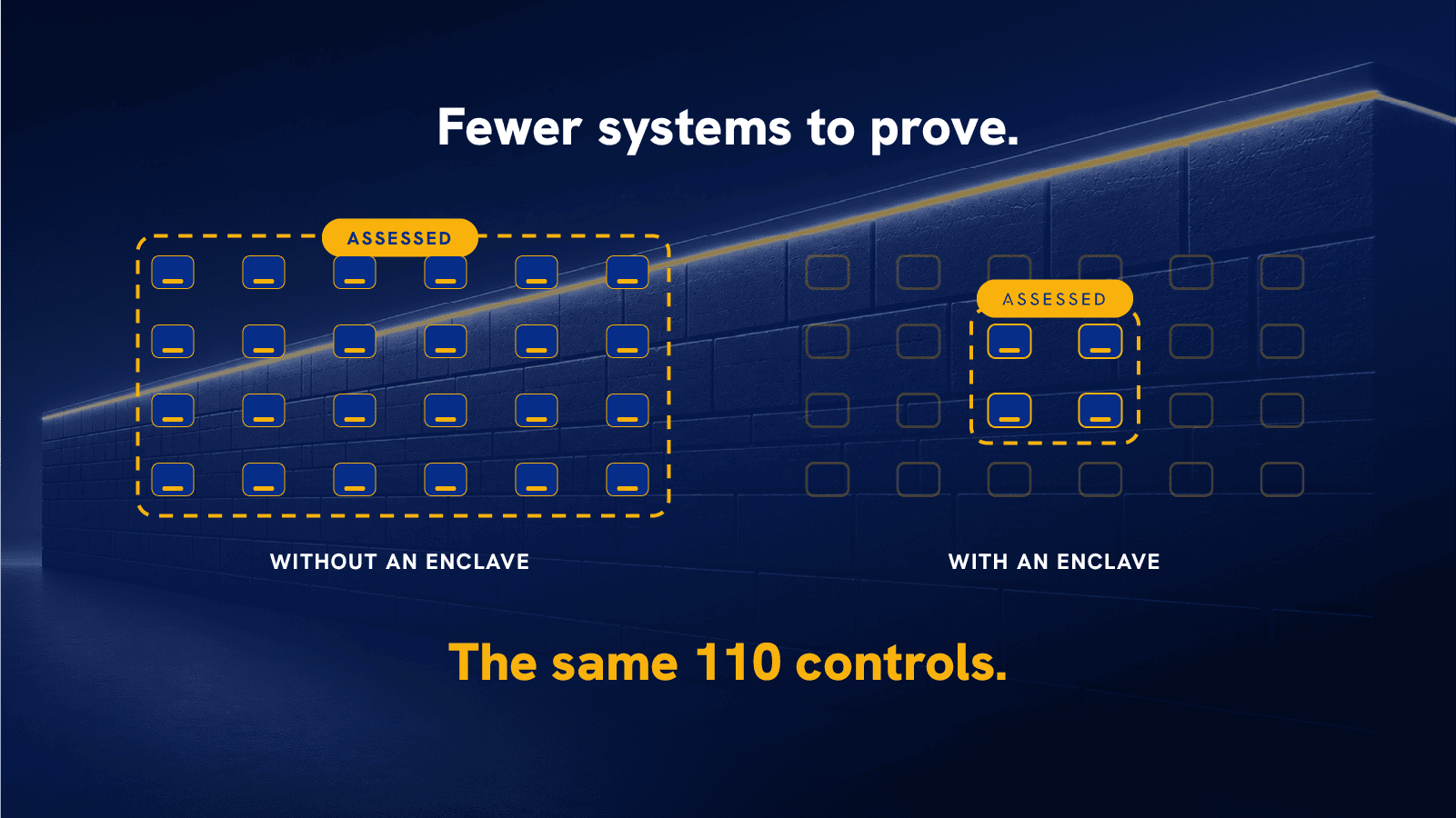
A CMMC enclave doesn’t lower your obligation. It lowers how much of your environment has to prove it.
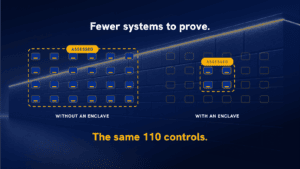
CMMC Level 2 applies to the systems that store, process, or transmit CUI, not to every system an organization runs. An enclave draws a hard boundary around those specific systems, so the assessment covers that boundary instead of the whole network. The controls stay identical either way. What changes is how many systems they get applied to.
What Actually Shrinks, and What Doesn’t
The 110 NIST SP 800-171 controls across 14 control families don’t change based on where CUI lives. An enclave doesn’t remove a single one of them. It changes the count of systems, users, and endpoints those controls get enforced on and assessed against.
That’s the entire mechanism. Access control, encryption, and monitoring get enforced in one defined zone instead of across an entire organization, which makes the controls easier to prove and the assessment faster to complete. Reducing scope reduces cost and audit footprint. It doesn’t reduce what the requirement actually demands.
The Boundary Has to Be Right Before Anything Gets Built
This is the same sequencing mistake that shows up in GCC High migrations, and it shows up here for the same reason: the boundary gets treated as a detail to confirm later instead of the decision everything else depends on.
An enclave can be virtual, physical, or hybrid, and which one fits depends entirely on how CUI actually moves through the organization, not on which option sounds simplest to stand up. Some organizations keep two accounts per person, a standard account and a separate enclave account for CUI. Others move affected users fully into the enclave so it becomes their only environment. Get the boundary wrong first, and the account model, the network segmentation, and the technology choice all inherit that mistake.
Define the boundary before any build work starts. Everything downstream, the architecture, the deployment, the validation, only holds up if that first decision was right.
Not Every Organization Should Build One
An enclave fits organizations that handle a limited, specific amount of CUI, want a smaller audit footprint, and have only a handful of people who actually touch that data.
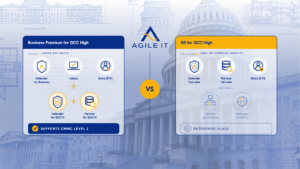
It fits less well when CUI is embedded across most teams rather than contained to a few, when an organization would rather outsource compliance entirely than manage a boundary, or when the added licensing cost of moving a subset of users into a GCC High environment doesn’t make sense against the budget. A more restrictive security posture inside the enclave can also disrupt how those specific users work, which is a real tradeoff, not a footnote.
When the fit isn’t there, full CMMC Level 2 compliance across the environment is the more direct path. See what that looks like before assuming an enclave is the default answer.
The Certification Is the Advantage, Not the Enclave
The advantage was never the enclave itself. It’s holding the certification. An enclave built on GCC High covers a significant share of the technical controls and reduces what an assessor has to review, which makes the certification more achievable and less expensive to pursue. The enclave is the path. The certification is what actually gates the contract.
The DoW pause on Phase 2 implementation hasn’t changed any of this. The timeline moved. The underlying requirement to protect CUI, and the contract eligibility tied to it, did not.
What It Takes to Build One Correctly
Discovery and planning come first: identifying where CUI actually lives, how it moves, and who touches it, before any boundary gets drawn. Design follows, choosing virtual, physical, or hybrid architecture based on that discovery, not before it. Deployment builds the systems and applies the required controls against that specific scope.
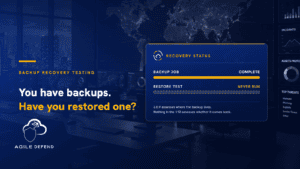
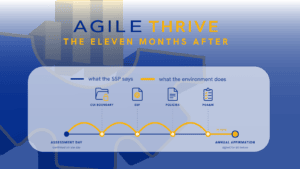
Validation tests the configuration against the defined boundary and closes gaps before an assessor finds them. Then operations takes over: monitoring, user training, and continuous evidence collection, because certification is the first step, not the finish line. Annual affirmation and re-assessment are required regardless of how clean the original build was.
Which decision has your organization actually made, where CUI lives and what boundary that draws, and which one is still an assumption nobody’s tested yet?
See the full enclave build process, cost guidance, and qualifying questions on Agile IT’s CMMC Enclave page.
CMMC Enclave FAQs
What is a CMMC enclave, and why would I need one?
A CMMC enclave is a segmented IT environment used specifically for handling Controlled Unclassified Information. Instead of applying CMMC requirements to your entire infrastructure, an enclave limits the compliance boundary, making it faster, cheaper, and easier to meet CMMC 2.0 standards.
Is an enclave required for CMMC certification?
No, an enclave isn’t required, but it’s often the most efficient and cost-effective approach for organizations that only handle CUI in specific roles or departments. By using an enclave, you reduce the number of systems and users in scope for your audit.
Can an enclave be hosted in the cloud?
Yes. CMMC enclaves can be deployed on-premises, in a virtualized private cloud, or in a compliant public cloud environment such as Microsoft GCC High or Azure Government. The choice depends on your business needs and IT strategy.
How long does it take to implement a CMMC enclave?
The timeline depends on your current infrastructure, the complexity of your environment, and how much preparation has already been done. For many defense contractors, Agile IT can help plan, implement, and validate a CMMC enclave in a matter of weeks.
What’s included in the Agile IT CMMC Enclave service?
CUI data flow discovery and scoping, network segmentation and boundary design, deployment of compliant controls including access, encryption, and logging, user training and documentation, and ongoing support as part of a managed offering if needed.
What makes Agile IT qualified to deliver CMMC enclaves?
Agile IT is a four-time Microsoft Partner of the Year, one of the original six authorized AOS-G partners, and a CMMC Registered Provider Organization (RPO).
How much does a CMMC enclave cost?
Costs vary depending on infrastructure size, licensing, and scope. Implementing a focused enclave is usually appreciably more affordable than applying CMMC controls across an entire network.