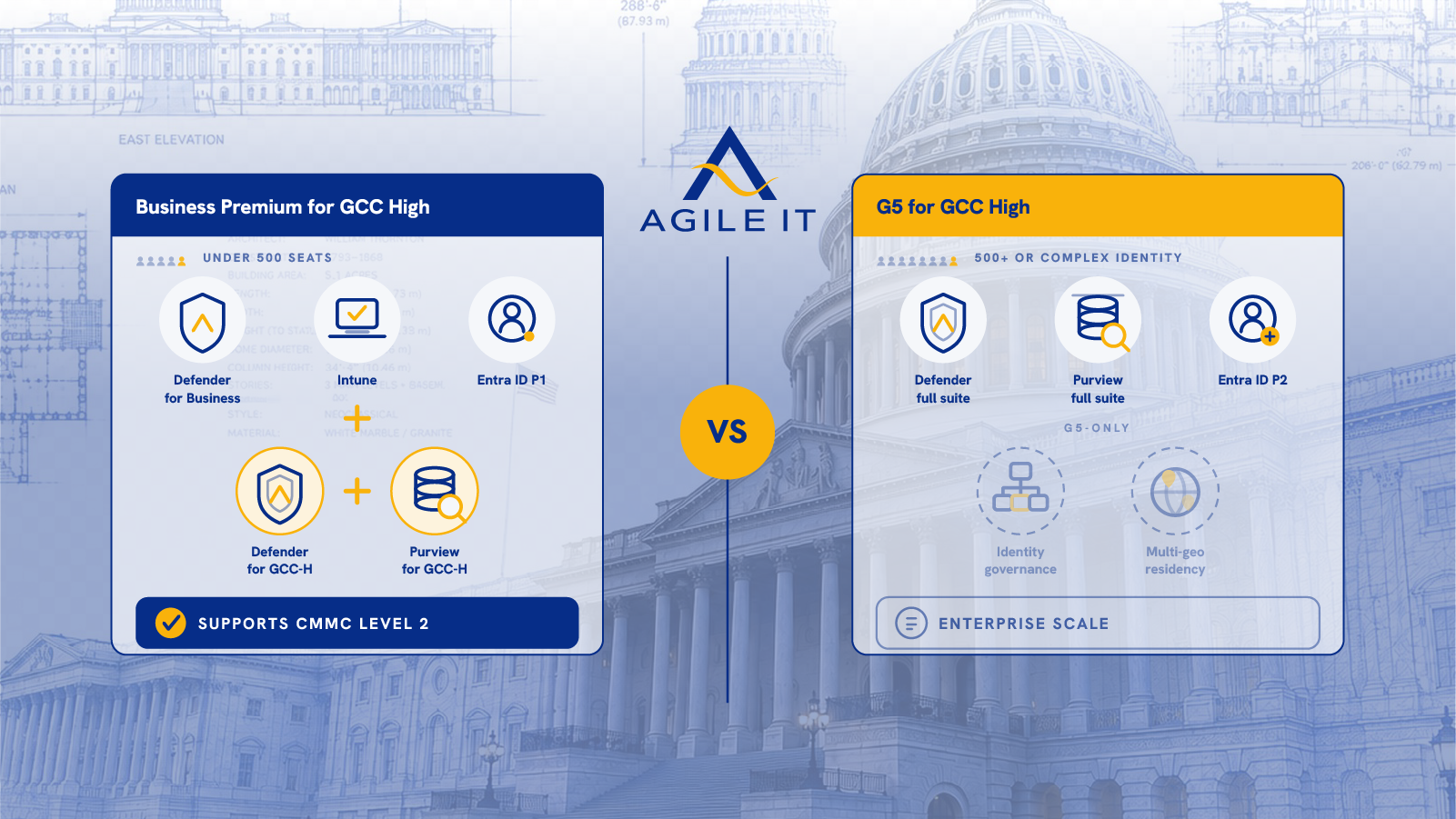
Microsoft built Business Premium for GCC High because most smaller contractors don’t need everything a G5 license includes. They need the specific controls CMMC Level 2 requires, and G5 is one way to get there, not the only one.
What Business Premium for GCC High Actually Covers
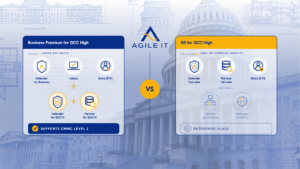
Microsoft announced Business Premium for GCC High as a purpose-built plan for organizations under 500 seats. It carries the familiar productivity stack plus foundational security: Microsoft Defender for Business, Intune, and Entra ID P1.
On its own, that’s roughly the GCC High equivalent of a mid-tier commercial plan. It wasn’t designed to carry the full compliance load by itself.
The Defender for GCC-H and Purview for GCC-H add-ons close that gap. Per Microsoft’s own announcement, when paired with Business Premium for GCC High, these add-ons provide the required security and compliance capabilities to support customers in meeting CMMC Level 2 requirements. That’s Microsoft’s own positioning, not a reseller’s interpretation of it.
What G5 Still Covers That the Add-On Stack Doesn’t
G5 includes the full Defender and Purview suites natively, along with Entra ID P2. The Business Premium plus add-on combination reaches near parity on the controls that matter for a baseline NIST SP 800-171 environment, but it isn’t identical to G5.
Broader identity governance tooling, multi-geo data residency options, and some of the larger-scale administrative controls stay G5-exclusive. An organization running a single-site operation under 500 seats is unlikely to need most of that. An organization scaling past that ceiling, or running a more complex identity environment, will.
The honest version of this comparison isn’t “Business Premium matches G5.” It’s “Business Premium plus the right add-ons covers what a smaller contractor’s CMMC Level 2 environment actually needs, and G5 covers that plus a layer of enterprise-scale capability most smaller contractors aren’t using yet.”
Moving to G5 Later Isn’t a New Migration
If an organization outgrows the 500-seat range, moving to G5 doesn’t mean standing up a new tenant. Microsoft’s own documentation on changing plans states that user data, including Exchange mailboxes and SharePoint content, is retained through the change.
It isn’t a single click, either. Business Premium sits in a different license family than G5, so the move gets handled as a manual plan switch, not an automatic in-place upgrade. Licenses get purchased and reassigned per user. The data stays where it is. The licensing work still has to happen.
Why This Matters Specifically for Smaller Contractors
The 500-seat ceiling isn’t a limitation bolted on afterward. It’s the design target. Microsoft positioned this plan specifically for smaller organizations, the kind that need to meet the same federal requirements as a prime but don’t have a prime’s headcount or budget to do it: a forty-person precision parts shop, a regional engineering firm on a single defense contract, an IT team of two supporting three hundred users.
That matters because the underlying requirement doesn’t scale down. DFARS 252.204-7012 and NIST SP 800-171 apply the same way to a 40-person machine shop as they do to a 4,000-person prime. The licensing path to meet them can scale down. The requirement can’t.
A license that supports the requirement still isn’t the same as an environment configured to meet it. The add-ons have to be turned on, mapped to the actual controls they’re meant to cover, and verified, not just purchased.
If your organization is under 500 seats and hasn’t compared what Business Premium for GCC High with the compliance add-ons would actually cover against your current environment, is that worth a conversation before your next renewal decides it for you?
Business Premium for GCC High vs. G5 FAQs
What’s included in Business Premium for GCC High by default?
The core productivity stack plus foundational security: Microsoft Defender for Business, Intune, and Entra ID P1. It’s designed for organizations under 500 seats.
Do the Defender and Purview GCC-H add-ons make Business Premium equivalent to G5?
Not identical. The combination reaches near parity on the controls most smaller contractors need for a NIST SP 800-171 baseline, but G5 still includes broader identity governance and multi-geo capabilities most smaller organizations aren’t using.
Is Business Premium for GCC High, with the add-ons, enough for CMMC Level 2?
Per Microsoft’s own announcement, the Defender and Purview GCC-H add-ons paired with Business Premium for GCC High provide the security and compliance capabilities to support CMMC Level 2 requirements. Whether a specific environment actually meets the requirement still depends on how those add-ons are configured, not just whether they’re licensed.
When does an organization actually need G5 instead?
Once an organization grows past the 500-seat range, or needs enterprise-scale identity governance, multi-geo data residency, or administrative capabilities the add-on stack doesn’t reach, G5 becomes the more direct path.
Does moving from Business Premium to G5 later require a new migration?
No. Microsoft’s own documentation confirms user data, including mailboxes and SharePoint content, carries over through a plan change. It’s a manual license switch rather than an automatic upgrade, so licenses have to be reassigned, but the environment itself doesn’t get rebuilt.