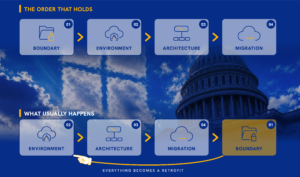
Azure Government and commercial Azure aren’t different tiers of the same thing. They’re different answers to different questions.
The question commercial Azure answers is: does this environment meet the security baseline the government requires. The question Azure Government answers is: does this environment also restrict who can touch it, and where it physically runs. Conflating the two is what sends organizations into this decision asking the wrong question.
The Compliance Boundary Is Closer Than Most Organizations Assume
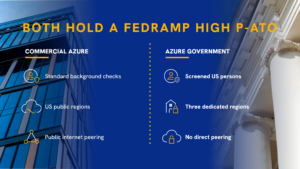
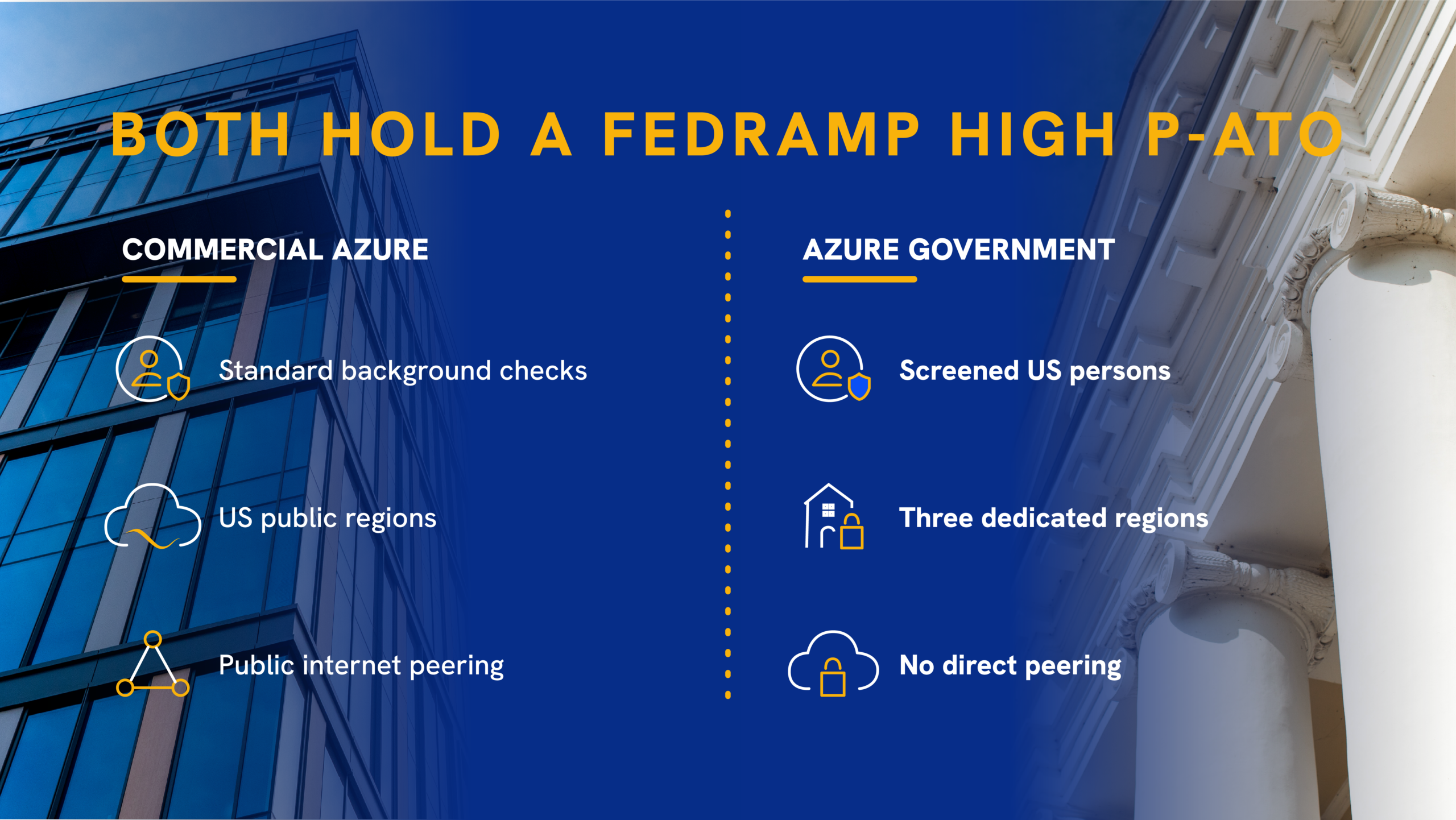
Both environments hold a FedRAMP High Provisional Authorization to Operate from the Joint Authorization Board. Microsoft states this directly: “Both Azure and Azure Government maintain FedRAMP High P-ATOs issued by the JAB,” on top of more than 400 Moderate and High ATOs issued by individual federal agencies for in-scope services. Commercial Azure’s P-ATO covers its United States public regions specifically. Regions outside the US aren’t in that scope.
Personnel, Not Certification, Is the Real Dividing Line
Microsoft draws the actual line between the two environments around who can access the data, not which controls are certified. Azure Government “provides additional customer assurances through controls that limit potential access to systems processing customer data to screened US persons.” Personnel with that access undergo a Tier 3 Investigation and citizenship verification. Commercial Azure staff still pass Microsoft’s standard background checks. They don’t clear that additional bar.
Region Is a Physical Fact, Not a Configuration Setting
Azure Government runs from three dedicated regions: US Gov Arizona, US Gov Texas, and US Gov Virginia. The isolation is physical, not logical only: separate hardware, biometric access controls, and no direct peering with the public internet or Microsoft’s corporate network. Azure Government reaches the internet only by routing through the commercial Azure network’s transport capability. Commercial Azure’s regions carry none of those restrictions.
The Question That Actually Decides This
DFARS 252.204-7012(b)(2)(ii)(D) sets the real trigger. It applies “if the Contractor intends to use an external cloud service provider to store, process, or transmit any covered defense information,” and it requires that provider to meet security equivalent to the FedRAMP Moderate baseline. Nothing in that clause names Azure Government by name.
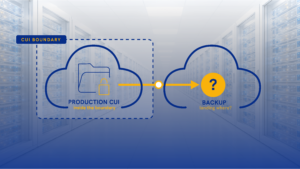
A workload that is provably outside the CUI boundary, one that never stores, processes, or transmits covered defense information, doesn’t trigger the clause at all. Commercial Azure is defensible there, on the strength of scope, not on the strength of the platform. Since commercial Azure’s US regions already hold FedRAMP High, a level above the Moderate baseline the clause requires, a workload that does fall inside the boundary can, in principle, still meet that specific requirement on commercial Azure.
What commercial Azure doesn’t give that workload is the personnel and physical restriction Azure Government was built around. Whether that gap matters depends on what else is riding on the contract: a prime’s flow-down requirement, a program office’s own architecture standard, or a decision the organization made and can defend on its own terms. The FedRAMP clause alone doesn’t require it. Something else usually does.
The Misconception That Costs the Most
Organizations tend to bring one assumption into this decision before any of the above gets discussed: that Azure Government is the requirement, rather than one way of satisfying a requirement that is really about scope and access control. That assumption skips the actual question, which is whether the workload sits inside the CUI boundary in the first place, and if it does, what specifically is asking for screened-personnel access on top of the FedRAMP baseline.
Over-scoping into Azure Government for a workload that was never in the boundary spends budget a defensible architecture didn’t need to spend. Under-scoping a workload that is in the boundary, and assuming commercial Azure alone closes the question, leaves a gap the next assessment finds.
Which Question Is This Workload Actually Answering?
Is this workload storing, processing, or transmitting covered defense information, or has it been treated that way without anyone checking?