
GCC High Licensing and G3 vs. G5 Start With CMMC Scope
Microsoft licensing is the last decision in the chain, and it is the one most organizations make first. The contract, the data, and the Cybersecurity Maturity Model Certification (CMMC) Assessment Scope decide the Microsoft cloud and the licensing tier inside it.
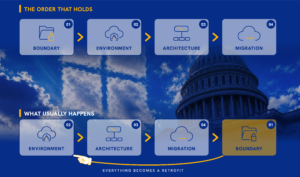
The chain runs in one direction: contract, data, assessment scope, Microsoft environment, licensing tier, control design, evidence. Work it backward from a seat count and the cost lands twice, once in capabilities the design never called for, again when the tenant is wrong for the data.
The Contract Establishes What The Microsoft Environment Must Support
DFARS 252.204-7012 establishes safeguarding requirements for covered contractor information systems. Where it applies, the contractor must provide adequate security for those systems.
Paragraph (b)(2)(i) subjects that system to the security requirements in NIST SP 800-171 in effect when the solicitation is issued, or as authorized by the Contracting Officer. The clause names no revision of its own.
Paragraph (b)(2)(ii)(D) adds two obligations where an external cloud service provider will store, process, or transmit covered defense information. The contractor must require and ensure the provider meets security requirements equivalent to the Federal Risk and Authorization Management Program (FedRAMP) Moderate baseline.
The same paragraph requires the contractor to ensure the provider complies with paragraphs (c) through (g), covering incident reporting, malicious software, media preservation, forensic access, and damage assessment. A provider that clears the baseline and will not commit to the rest does not satisfy the paragraph.
Getting those commitments in writing from a hyperscaler moves at procurement speed, not engineering speed.
The Microsoft environment is now an architecture decision. Commercial Microsoft 365, Government Community Cloud (GCC), GCC High, and Office 365 DoD carry different commitments, documented in Microsoft’s Office 365 US Government service descriptions.
The Phase 2 Suspension Changed What Can Be Required, Not What Applies
The Department of War (DoW) suspended CMMC Phase 2 on July 13, 2026. The transition had been set for November 10, 2026.
The DoW Chief Information Officer memorandum states that during the suspension the Department will enforce baseline compliance with NIST SP 800-171 Revision 2 through CMMC Level 1 and Level 2 self-assessment. The same document states that DFARS 252.204-7012 requirements remain in effect.
Requiring activities may now designate only Level 1 (Self) or Level 2 (Self). The Department published no replacement date, directing a 60-day review instead.
That constrains what contracting activities may require going forward. A clause already in a signed contract stays where it is. The environment decision was driven by the clause and the data, and both are unchanged.
CMMC Assessment Scope And User Count Answer Different Questions
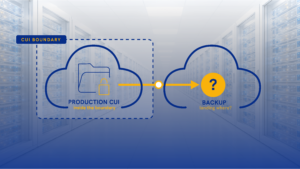
The CMMC Assessment Scope follows the assets involved with CUI and the assets providing security functions to that environment. User count answers a different question: how many people need Microsoft licensing.
32 CFR 170.19 requires the scope to be specified before a Level 2 self-assessment or certification assessment begins, and Table 3 defines the asset categories. CUI Assets process, store, or transmit CUI. Security Protection Assets provide security functions or capabilities to the assessment scope.
Consider an employee who never opens a CUI document. The Microsoft services protecting the systems where CUI is handled are still Security Protection Assets, and Table 3 requires them documented in the asset inventory, the System Security Plan (SSP), and the network diagram.
Those assets are assessed against Level 2 requirements relevant to the capabilities provided. Contractor Risk Managed Assets sit under a different rule in the same table.
Assigning a higher tier across the organization raises the invoice while the scoping question stays open.
G3 Versus G5 Follows The Control Design
G3 and G5 determine which Microsoft capabilities are available to support a control design. CMMC establishes what the environment has to satisfy.
Where DFARS 252.204-7021 applies, the contractor must have and maintain a current CMMC status at the level the Contracting Officer inserts into the clause, for every system used in performance of the contract that processes, stores, or transmits Federal Contract Information (FCI) or CUI.
No level appears in the regulation itself. Paragraph (d)(1)(i) is a fill-in.
Microsoft documents G3 as including Defender for Endpoint Plan 1, and lists the G5 and G5 Security offerings among the Defender for Endpoint licensing options for GCC, GCC High, and DoD.
Capability availability also depends on the Microsoft environment. Microsoft states that Defender for Endpoint for US Government customers does not have complete parity with the commercial offering, naming gaps that include Microsoft Threat Experts and enterprise Internet of Things (IoT) security.
GCC And GCC High Carry Different Microsoft Commitments
Microsoft describes GCC as an environment for eligible government entities and organizations handling government-regulated or controlled data. Its published commitments for GCC include FedRAMP High and DFARS.
Microsoft offers GCC High to the Department of Defense (DoD) and to contractors holding or processing DoD Controlled Unclassified Information (CUI) or data subject to the International Traffic in Arms Regulations (ITAR). Microsoft agrees to ITAR contract language only for GCC High.
Read Microsoft’s Impact Level sentence in full. It first conditions the claim on an environment “assessed using NIST SP 800-53 controls at a FIPS 199 High Categorization.” Only then does the sentence reach “equivalency to IL4 or necessary inheritance for CMMC.”
Equivalency to Impact Level 4 is not an IL4 authorization, and inheritance is what your assessment uses rather than something the platform holds for you. Microsoft’s CMMC page puts it more carefully, saying GCC High “supports organizations in meeting CMMC Level 2 and Level 3 requirements (when configured appropriately).” The parenthetical is the work.
Conditional access, retention, and information protection all operate inside the cloud already provisioned. Moving a workload to a different government environment is a tenant migration, not a configuration change.
GCC High Procurement Runs Through Eligibility And An Authorized Channel
Microsoft controls eligibility for its government environments and the channels used to acquire them. Its Microsoft 365 Government purchasing documentation lists GCC High through an Enterprise Agreement with a Licensed Solution Provider (LSP), or through the Agreement for Online Services for Government (AOS-G) channel.
Cloud Solution Provider appears in the GCC column only. Office 365 DoD is Enterprise Agreement and nothing else.
Microsoft frames Enterprise Agreement and LSP at 500 seats and above in its section headings, and AOS-G at under 500 seats. It maintains separate AOS-G lists for GCC and GCC High, and for GCC alone.
Microsoft requires eligibility validation before the environment is established, and revalidation at renewal. Validation may require proof of ITAR registration with the State Department. Microsoft publishes no timeframe for the process.
Microsoft lists Agile IT on the AOS-G list covering GCC and GCC High under 500 seats.
Resolve eligibility and channel authorization before provisioning begins. A reseller that cannot transact your environment surfaces after the dates are committed.
Microsoft 365 Pricing Accounts For Part Of The Architecture
Per-user Microsoft 365 pricing covers the licenses assigned to users. Where the regulated workload requires Azure services, the architecture also carries compute, storage, networking, logging, and security consumption outside those seat licenses.
DFARS 252.204-7012 paragraph (e) turns one of those costs into a contract obligation. A contractor who discovers a cyber incident must preserve system images and all relevant monitoring and packet capture data for at least 90 days, running from submission of the incident report.
Data has to exist before the incident to be preserved after it. Microsoft Sentinel bills analytics by the gigabyte ingested, with commitment tiers starting at 100 GB per day and retention at no charge for the first 90 days.
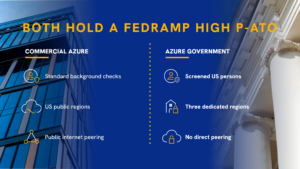
The workload requirements determine whether those Azure services belong in Azure Commercial or Azure Government. Microsoft states that both carry the same security controls, that a third-party assessment organization has attested both for CUI workloads, and that the environment decision rests with the customer.
Azure Government adds contractual commitments: customer data stored in the United States, and access to systems processing it limited to screened US persons. Microsoft raises export control as why that difference matters, which is where ITAR-driven workloads land.
Assessment Evidence Comes From Implementation, Not Entitlement
Assessment evidence has to support how the requirement is implemented within the environment. A Microsoft entitlement establishes access to a capability, and stops there.
DFARS 252.204-7021 also requires an annual affirmation of continuous compliance in the Supplier Performance Risk System (SPRS), submitted by the affirming official. The clause defines “current,” and that definition does real work: a Level 2 certification assessment runs 3 years, while the affirmation cannot be older than 1 year.
A 3-year certificate sitting next to a 13-month-old affirmation is not a current CMMC status.
Microsoft Defender makes the difference concrete. Purchasing the license makes the capability available, and an assessor asks who configured it, who reviews the output, and what happened last time it flagged something.
Operating records accumulate over months, and no purchase order shortens that.
Pressure-test the Microsoft government licensing against the environment you are building.
Microsoft Licensing And CMMC FAQs
Does Commercial Microsoft 365 Meet CMMC Level 2?
The contract, the information being handled, the CMMC Assessment Scope, and the implementation determine what the environment has to support. CMMC Level 2 designates no Microsoft 365 SKU that satisfies its requirements on its own. DFARS 252.204-7012 adds requirements for covered contractor information systems and for external cloud service providers.
Do I Need GCC High To Handle CUI?
The applicable contract and data requirements establish the commitments the Microsoft environment needs, and CUI alone does not settle the question. Microsoft offers GCC High to the Department of Defense and to contractors holding or processing DoD CUI or ITAR-controlled data, and agrees to ITAR contract language only for GCC High.
Can I Buy GCC High From Any Microsoft Reseller?
Microsoft specifies the purchasing channels for GCC High and requires eligibility validation first. Its Microsoft 365 Government purchasing documentation lists an Enterprise Agreement through a Licensed Solution Provider and the Agreement for Online Services for Government channel. A reseller authorized for GCC is not automatically authorized for GCC High.
Did The Phase 2 Suspension Change My DFARS Obligations?
The DoW Chief Information Officer memorandum suspending CMMC Phase 2 states that DFARS 252.204-7012 requirements remain in effect. During the suspension the Department will enforce NIST SP 800-171 Revision 2 through Level 1 and Level 2 self-assessment. No replacement date was published, and a signed contract is unaffected.
Confirm The Microsoft Licensing Before The Architecture Depends On It
Microsoft licensing gets expensive to unwind after users, data, controls, and Azure services depend on the original decision. An unsupported assumption anywhere in that chain belongs back in the architecture discussion first.
Pressure-test the Microsoft government licensing against the environment you are building.
Which assumption in your Microsoft environment would be hardest to support with the contract, architecture, and evidence you have today?