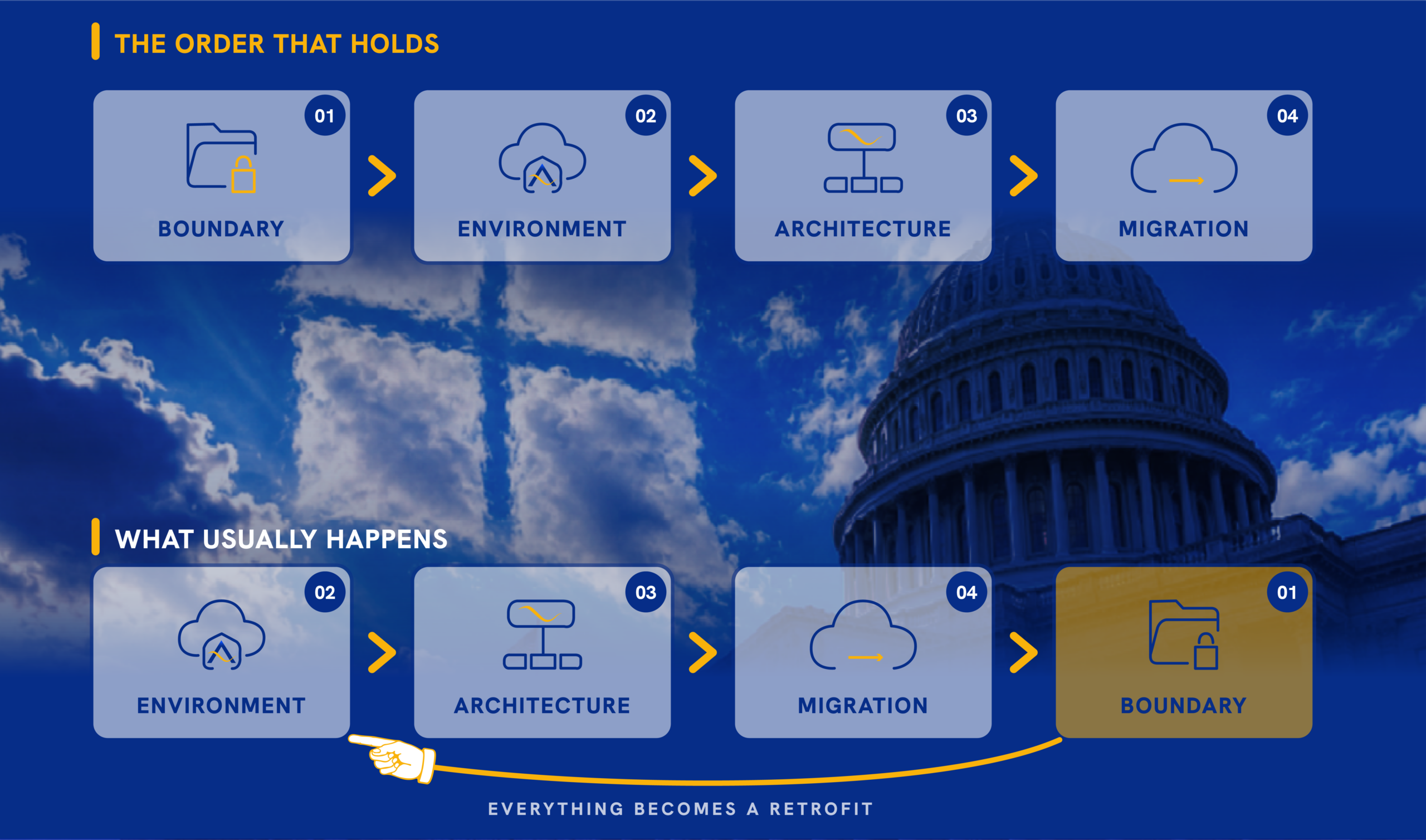
When the boundary gets defined last and the environment gets locked in first, that’s what makes the failure expensive.
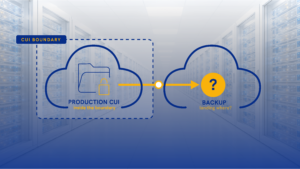
GCC High migrations that fail didn’t break on a technical error; they broke on order. The CUI boundary got defined after the environment was already chosen, and every architectural decision after that had to justify a scope nobody had written down.
Every migration proposal gets reviewed for technical risk: identity federation, mail flow cutover, data loss during transfer. Sequencing risk doesn’t show up on that list.
It surfaces later, the first time an assessor or a prime’s security questionnaire asks a scoping question the organization can’t answer cleanly. By then the tenant, the licensing tier, and the identity structure are already built around whatever assumptions filled the gap where a documented boundary should have been.
The Sequence That Holds Up
Boundary, then environment, then architecture, then migration. That’s the order, and it rarely runs that way.
Most engagements arrive with environment and licensing already selected, sometimes with a signed purchase order, and architecture and identity governance still undefined. Boundary shows up last, forced out by that same scoping question when it finally lands.
Scope authority traces to the designating agency under 32 CFR Part 2002, not to whichever prime is easiest to ask. A boundary built on internal assumptions instead of what the designating agency and the contract’s own CUI markings require won’t hold up to that question.
Once environment is chosen first, everything downstream becomes a retrofit. Retrofitted architecture still counts as architecture, but now it has to justify a boundary after the fact instead of enforcing one that already existed. An assessor reading the timeline sees the licensing agreement dated before the scoping memo and draws the obvious conclusion.
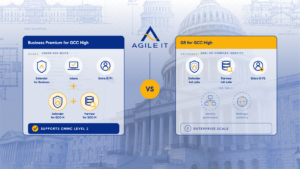
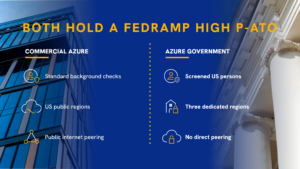
Not every CUI boundary needs GCC High. Some need GCC. Some, depending on ITAR exposure and data residency requirements, need Azure Government layered underneath.
Skipping the boundary work means guessing at that tier instead of deriving it from the data. The guess runs in both directions: an organization that overbuys carries licensing cost for controls it never needed to evidence, and one that underbuys ends up in an environment that can’t carry what its own boundary requires.
Why Environment Gets Chosen First
The reversal is rarely bad judgment. It’s a mismatch of timelines. A prime’s flow-down requirement comes with a contract deadline, and a Microsoft partner’s proposal comes with a licensing cost and a start date.
A boundary exercise done properly takes longer than either party wants to wait: interviewing the people who handle CUI, tracing where it flows in practice, reconciling that against the CUI Registry and the contract’s own marking requirements.
Environment gets picked on the timeline with a deadline attached. Boundary work gets scheduled for after go-live, where it competes with every other post-migration priority and usually loses. That’s what happens when the wrong calendar governs the decision, not a failure of the people running the migration.
The Reform Task Force’s public comment period on its reform RFI closed August 14, with recommendations expected roughly sixty days after the July 13 suspension. (DoW RFI, via SBA Office of Advocacy) That review adds one more calendar pulling attention toward what CMMC becomes next, and away from the boundary work an organization owes itself regardless of where it lands.
Where Each Stage Breaks
Tenant configuration and identity governance get locked in before the boundary exists. That’s an irreversible decision: expensive and disruptive to unwind once users, mailboxes, and conditional access policies depend on it.
A contractor that stands up one GCC High tenant for the whole organization, because that was the simplest licensing conversation, has made a scoping decision without calling it one. If the boundary later turns out to be a segment of the business rather than the whole thing, nobody goes back and fixes the tenant.
Splitting a tenant after two thousand mailboxes and a year of conditional access policies are built on top means re-provisioning identities, cutting over mail flow, and reassigning licenses, done while the business keeps running. Microsoft’s own tenant-to-tenant migration guidance treats that as a full project: identity remapping, license reassignment, and mail routing sequencing, the same categories of work as the original migration.
Licensing gets chosen the same way, ahead of knowing which controls it has to evidence. A GCC High or Azure Government license satisfies the hosting and data residency requirement in DFARS 252.204-7012. NIST SP 800-171 compliance is a separate, ongoing requirement the license doesn’t cover by itself.
Which SKU, which add-ons, which retention settings, all of it depends on which of the 110 controls the environment has to carry evidence for: audit log retention, access control enforcement, media protection. Pick the tier first and the gap surfaces at the next add-on purchase, or worse, mid-assessment, as a change order instead of a line item.
Migration gets executed before conditional access and audit logging are architected, not deployed. A conditional access policy that was never mapped to a control, or logging that’s switched on but not retained on a schedule, is deployed and nothing more.
Move live CUI into that environment before the gap closes, and the organization is protecting data inside a structure it can’t yet describe on paper. That gap doesn’t surface during the migration. It surfaces the first time someone outside the organization asks to see the policy in writing.
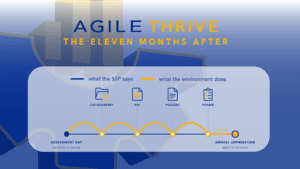
The pattern underneath all three is acceleration without alignment: the migration moves at the calendar’s pace, the governance work that makes the environment defensible moves at whatever pace is left over, usually nobody’s. The data arrives before the paperwork does, and once it’s there, the paperwork is describing a decision that already happened instead of one still open for review.
What a Microsoft Partner Should Be Asked Before the Agreement Is Signed
The sequencing problem usually surfaces first in the sales conversation, because that conversation runs on the licensing timeline, not the boundary timeline. A partner can describe what GCC High includes. Whether that matches the organization’s actual CUI boundary is a different question, and it’s the organization’s to ask.
Worth asking before signature: which control families the proposed tenant configuration is meant to evidence, not just support. Whether the structure assumes one enterprise-wide boundary or a narrower enclave, and which one matches the boundary work already done. Whether conditional access and logging get built to a documented set of controls or shipped as a default to adjust later.
A partner who can’t answer against a boundary document, because none exists yet, has confirmed the sequence is running environment-first.
None of this is a criticism of the partner. A licensing conversation is structured to answer licensing questions, and a good one says so directly rather than improvising an answer to a scoping question that belongs to the organization. The problem is that conversation happening as the first decision instead of the third.
What It Costs to Reorder After the Fact
Reordering after go-live means reopening tenant architecture that live users already depend on, and remapping a control set onto a license that may not carry what the boundary needs. Microsoft’s own migration guidance treats a tenant restructuring as a full project on the same scale as the original migration: identity remapping, mail flow cutover, and license reassignment, done while the business keeps running.
The organizations that avoid this can say, before the migration starts, which decision got locked in first and whether it was made against a documented boundary or a licensing conversation.
The exposure isn’t limited to a future assessment. An inaccurate SPRS score is a representation the government can already act on under the False Claims Act. In September 2025, the Department of Justice settled with Georgia Tech Research Corporation for $875,000 over cybersecurity compliance claims that didn’t match the environment they described. That exposure exists independent of whether CMMC Phase II ever returns in its original form.
Three Questions a Working Tenant Doesn’t Answer
A tenant that’s live, populated, and functioning proves the migration succeeded. Whether the boundary was ever written down, whether the license maps to what it needs to evidence, and whether conditional access and logging were architected rather than switched on are three separate questions a working environment can’t answer by itself.
GCC High and “compliant with NIST SP 800-171” get treated as the same fact more often than not. GCC High satisfies a hosting and data residency requirement. Whether the organization’s controls hold up under NIST SP 800-171 is a separate, ongoing question the environment can’t answer by itself.
The CMMC Phase II suspension doesn’t change any of it. Phase I self-assessment, DFARS 252.204-7012 safeguarding, SPRS reporting, and annual affirmation are still active regardless of where the reform review lands. Reading the pause as room to slow down the boundary work runs the wrong direction.
The next irreversible step in most of these environments is the identity and tenant decision that has to hold for years, not the migration itself. Before that locks in, the question that matters is which order the decisions arrived in, and whether that order would hold up if someone asked to see it.
Compliance is an operating state, not a milestone. A new contract, a new CUI category, or a business unit added to scope reopens the same sequencing question.
Our GCC High licensing guidance walks through how tier selection maps to control evidence.
Which order were your decisions made in?
GCC High Migration FAQs
Draft. Marketing lead to approve or answer. Substantively unchanged except where noted below.
What’s the right order of decisions in a GCC High migration?
Boundary, then environment, then architecture, then migration. Document what CUI the organization handles before selecting GCC High, GCC, or Azure Government, build identity governance and audit logging to enforce that boundary, then migrate.
Why is identity governance considered an “irreversible” decision in a migration?
Once tenant structure and conditional access policies have live users and mailboxes built on top of them, changing that structure means redoing identity, mail routing, and licensing work, the same categories of work as the original migration.
Does being in GCC High automatically mean CUI is handled compliantly?
No. GCC High satisfies a hosting and data residency requirement under DFARS 252.204-7012. Whether the organization’s controls meet NIST SP 800-171 is a separate, ongoing question the environment doesn’t answer on its own.
What should a contractor ask a Microsoft partner before signing a GCC High agreement?
Which control families the configuration is built to evidence, whether tenant structure matches a documented boundary or assumes one, and whether conditional access and logging are built to specific controls or left at default.
What does it cost to fix a migration that was sequenced in the wrong order?
Reopening tenant architecture and remapping controls after go-live means redoing identity, mail routing, and licensing work while the business keeps running, the same categories of work as the original migration. The exact cost varies by engagement; the direction doesn’t.